Emotions. A word so universal, yet so individual. Its synonyms are endless: feelings, moods, sentiments, states of mind… The quest to understand emotions spans all of history.
As a person who is concerned with climate change and its effects, I am interested in knowing more about how people process climate change, and how this threat affects their emotions and well-being.
People experience a diverse array of emotions in relation to what is happening with our planet. Dealing with these emotions is sometimes overwhelming, both for the people experiencing them and for the people trying to help them. This is particularly challenging for mental health professionals and climate communicators, who need practical frameworks to guide and support others.
It is with this vision that the Climate Mental Health Network (CMHN) created the Climate Emotions Wheel. The wheel is intended to be a tool to identify climate emotions. As mentioned on the CMHN website, the wheel is backed by research suggesting that simply recognizing and labeling a negative emotion, such as anxiety or fear, can reduce its intensity.
I found this tool to be powerful and a great potential help in dealing with climate emotions. Starting my research, I was not expecting to find such a rich history behind its origins.
Insights on Complexity and Unity. While the volume of research on climate emotions is increasing steadily, studies on basic emotions are innumerable. Compared to other subjects, I found that the study of emotions has no single, agreed-upon definitions, models, or classifications; instead, the field is a mosaic of approaches stretching back to the earliest known thinkers. I believe this complexity reflects the diversity of human culture. Though the paths of our internal lives are varied and complex, I believe we are unified as one people on one planet, sharing both the same essential emotional core and a common destiny.
The Wheel’s Intellectual Inheritance. This deep history of studying emotion provides the essential framework for modern tools like the Climate Emotions Wheel. The CMHN team based their work on Panu Pihkala’s article, Toward a Taxonomy of Climate Emotions. Sarah Newman started the project. Anya Kamenetz, along with the CMHN team, worked with Pihkala to create the wheel.
The result is a colorful wheel representing 23 climate emotions, separated into four categories: Anger (red), Positivity (blue), Sadness (purple), and Fear (green).
Climate Emotions Wheel
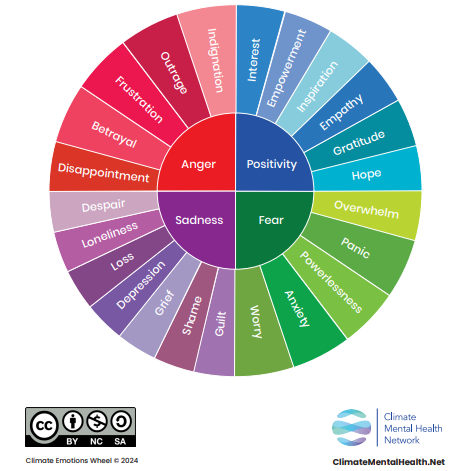
In his article, Pihkala suggests a taxonomy for climate emotions. His methodology was “a combination of a semi-structural review and a narrative review.” His work is based on a variety of sources. He principally used sources on climate and eco-emotions but turned to broader emotion research when specific emotions were not found in those primary sources.
From Woodworth to Plutchik: A Lineage of Design. Unsurprisingly, the development of this taxonomy draws from the deep history of emotion study. While Robert Plutchik’s theory of emotions is well-known, it is his iconic, visual Wheel of Emotions that has truly endured, serving as the structural template broadly used up to now.
Although different, Plutchik’s Emotions Wheel and the Climate Emotions Wheel have many similarities. Besides, Pihkala mentions Plutchik’s wheel in the Climate Change and Happiness podcast saying: “When I started to dig deeper into emotion studies, I remember that visualizations were very helpful—in addition to all this text that we have about emotions. Robert Plutchik has this famous emotions wheel and there are several versions available online.”
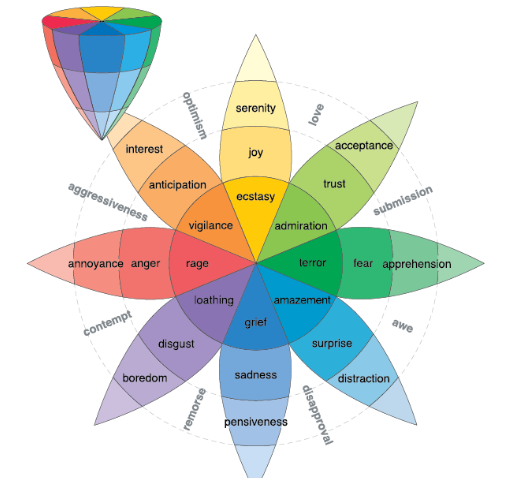
Plutchik’s Wheel of Emotions from “The Nature of Emotions: Human emotions have deep evolutionary roots, a fact that may explain their complexity and provide tools for clinical practice,” by R. Plutchik, 2001, American Scientist, 89(4), p. 349. Copyright 2001 by Sigma Xi, The Scientific Research Society.
Plutchik’s Emotions Wheel, with its radial, tiered design, was the inspiration for many other wheels as well. Gloria Willcox’s Feelings Wheel and the Geneva Emotions Wheel are two well-known examples.
Plutchik mentions being inspired by previous research when developing his wheel. He references Schlosberg’s circular scale and his subsequent addition of an intensity dimension, transforming the circle into a cone-shaped model. From there, Plutchik built his own cone-shaped model in 1958 with eight basic, bipolar emotions.
Schlosberg’s circular scale was created when he was reviewing Woodworth’s six-step scale of facial expression. Schlosberg realized that the emotions were not linear, but could be arranged in a circular manner, leading to the circumplex model.
The Cumulative Power of the Wheel. It is interesting, when we look back in time, to see that many steps have potentially led to the Climate Emotions Wheel. This cumulative knowledge is what allows us to create effective tools for helping ourselves and others navigate the emotional strain of the climate crisis. Ultimately, it is this same knowledge that can help us build the world we dream of: A world where we reclaim our planet and give it the care it deserves, and a world where humankind finally realizes it is one and that its destiny is also one.

is a third-year bachelor’s student in psychology at Carleton University. She is passionate about nature and mental health. She has previously volunteered in the development of the Luna Moth Circle online course: “Climate Change and Youth Mental Health.” and is an occasional volunteer at Earthub, an environmental organization in Ottawa. Chantal plans to pursue graduate studies in psychology, aiming to apply her knowledge to foster a better care of our planet and its people.
References
Climate Mental Health Network. (2023). The climate emotions wheel. https://www.climatementalhealth.net/wheel
Doherty, T., & Pihkala, P. (Hosts). (2023, October 27). The climate emotions wheel (Season 3, No. 5) [Audio podcast episode]. In Climate Change and Happiness. https://climatechangeandhappiness.com/episodes/season-3-episode-5-the-climate-emotions-wheel
Landmann, H. (2020). Emotions in the context of environmental protection: Theoretical considerations concerning emotion types, eliciting processes, and affect generalization. Umweltpsychologie, 24(2), 61–73.
Pihkala, P. (2022). Toward a taxonomy of climate emotions. Frontiers in Climate, 3, Article 738154. https://doi.org/10.3389/fclim.2021.738154
Plutchik, R., & Conte, H. R. (Eds.). (1997). Circumplex models of personality and emotions. American Psychological Association.
Plutchik, R. (2001). The nature of emotions: Human emotions have deep evolutionary roots, a fact that may explain their complexity and provide tools for clinical practice. American Scientist, 89(4), 344–350.
Scherer, K. R., Shuman, V., Fontaine, J. R. J., & Soriano, C. (2013). The GRID meets the wheel: Assessing emotional feeling via self-report. In J. R. J. Fontaine, K. R. Scherer, & C. Soriano (Eds.), Components of emotional meaning: A sourcebook (pp. 281–298). Oxford University Press.
Schlosberg, H. (1952). The description of facial expressions in terms of two dimensions. Journal of Experimental Psychology, 44(4), 229–237.
Schlosberg, H. (1954). Three dimensions of emotion. Psychological Review, 61, 81–88.
Snyder, H. (2019). Literature review as a research methodology: An overview and guidelines. Journal of Business Research, 104, 333–339. https://doi.org/10.1016/j.jbusres.2019.07.039
Willcox, G. (1982). The Feeling Wheel: A tool for expanding awareness of emotions and increasing spontaneity and intimacy. Transactional Analysis Journal, 12(4), 274–276. https://doi.org/10.1177/036215378201200411
Woodworth, R. S. Experimental psychology. New York: Holt, Rinehart and Winston, 1938
Additional Resources
The Climate Emotions Wheel and A Guide to Climate Emotions: https://www.climatementalhealth.net/wheel
Climate Emotions Toolkit for Educators: https://www.neefusa.org/what-we-do/health/climate-emotions-toolkit
Plutchik’s Emotion Wheel: What It Is and How to Use It: https://positivepsychology.com/emotion-wheel/